
Manual calling is something every sales team already does. Pick up the phone, dial the number, wait for it to ring and repeat. It works, but only until your lead list grows, your targets double and your reps start missing follow-ups because they are still stuck dialing.
Now here is the catch. Most people do not even know that there is a better way.
That better way is auto dialing.
It is not a fancy add-on. It is a game-changing shift in how your team handles outbound calls. But because it is less known, most business owners and sales managers miss out on the massive time and productivity boost it offers.
In this article, we will break down:
Let us start by breaking down both methods before we get into the comparison.
Manual dialing is exactly what it sounds like. Your sales rep looks at a lead’s phone number, enters it on the keypad, hits call, waits for it to connect and repeats this process for every single lead.
It is the most basic way to make sales calls, and most small businesses still use it. There is no software doing the heavy lifting. Just a rep, a phone and a lead list.
Manual dialing works fine when:
For example, if your team is calling just 15–20 leads a day and wants to have in-depth conversations, manual dialing might be enough.
As your business grows, so does your lead volume. And with manual dialing, your reps spend more time dialing and waiting than actually talking.
This leads to:
And that is where auto dialing enters the picture.
Related Read: What Is Telecalling? Features, Benefits, Top Software and More!
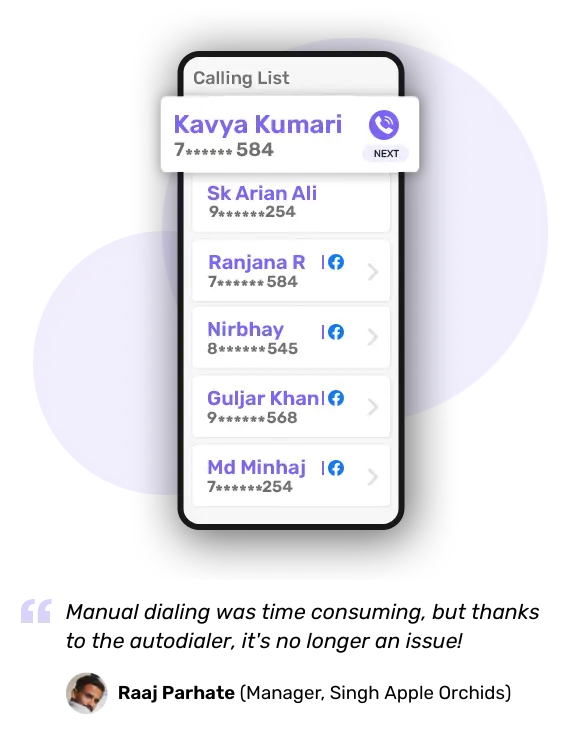
Auto dialing is when a software system automatically dials numbers from your lead list, so your sales reps do not have to do it manually. The system keeps calling one lead after another, and connects the rep only when someone picks up.
It removes the repetitive, low-value task of dialing numbers and lets your team focus on what actually matters — talking to prospects.
Let’s say you have a list of 100 leads.
With auto dialing, your rep just hits “Start Calling” on the screen, and the system does the rest:
Auto dialing works best when:
Let’s break it down like a business owner would. You’re not looking for technical fluff. You just want to know: “Will this save my team time, help me close more leads and actually make sense for my business?”
Here’s the difference.
Manual dialing is slow. Even if your rep is super-efficient, they can make around 15 to 20 calls an hour. Why? Because they’re spending time entering numbers, waiting for it to ring, dealing with busy tones and updating call outcomes manually.
Auto dialing flips that. The system dials one lead after another, skips unreachable numbers and connects only when someone picks up. Your rep goes from 15 calls an hour to 60 or even 100. That’s not an exaggeration — that’s the difference automation makes.
With manual dialing, your reps waste hours on things that have nothing to do with actual selling. They dial, wait, redial and type notes. It’s repetitive, boring, and honestly demotivating.
Auto dialing lets them skip all of that. They hit “Start”, and the system brings one lead after another. Notes, follow-ups and call logs can be added with one click or automated altogether. Reps stay focused, less tired and more consistent throughout the day.
Manual dialing often leads to missed follow-ups. A rep gets busy, forgets to update the sheet or simply loses track of who to call next. There’s no central system reminding them what’s pending.
With auto dialing (especially when tied to a CRM), follow-ups are built-in. You can set reminders, assign leads and make sure no lead falls through the cracks. Every call is logged, and every next step is crystal clear.
One of the biggest arguments in favour of manual dialing is the personal touch. And yes, it is true — when you’re calling a small list of high-value clients, you want that extra control.
But let’s be honest. For most businesses today, the problem is not too much personalisation. The problem is not enough reach. You need to follow up faster, handle more leads and close before the competition does.
Auto dialing helps you do that. And with CRM integration, reps still get all the context they need before a call — name, history, lead stage — so that the conversation still feels personal.
If you are just starting out, handling a few leads per day or selling high-ticket services where every call needs deep prep, manual dialing is fine.
But if you are scaling, running large campaigns, managing a sales team or losing deals because your team “forgot to follow up,” it’s time to switch.
Switching from manual dialing to auto dialer software might sound like a big leap, but it’s actually one of the easiest upgrades you can make to boost your team’s efficiency. Whether you’re running a small sales team or scaling a full-blown outbound engine like in call centers, this shift can save hours of manual work and help close more deals.
Let’s walk you through how to implement auto dialing the right way.
There are many types of dialers in the market, preview, progressive and predictive dialers being the most common. Most businesses don’t need the complexity of predictive dialing right away. Start with a basic auto dialer that’s built into a CRM.
Look for features like:
If you’re working with a high call volume and need scale, predictive dialers can come into the picture later. Predictive dialing software automatically calls multiple numbers at once and routes answered calls to available reps, but it also requires careful handling to avoid dropped calls and compliance issues.
Related Read: Best Contact Management Solutions for MSMEs in 2025
Before you set anything up, ask:
If your business needs high-volume calling (like in BPOs or customer support call centers), auto dialer software with predictive dialing capabilities can maximise call connects by filtering out busy signals, disconnected numbers and voicemails.
But if you’re doing consultative sales, a simpler auto dialer with lead preview is more effective than aggressive predictive dialers.
Your next step is to upload leads into the system. Make sure the lead data is clean — proper number format, no duplicates and relevant lead info like name, source and previous interaction (if any).
Many CRMs allow you to import leads from Excel or integrate with your website forms or ad campaigns. This makes the dialing process seamless from lead capture to first call.
Define:
Auto dialer software lets you assign call outcomes — such as “interested,” “not reachable,” “busy signal,” or “follow-up needed” — with just one click. This simplifies the entire dialing process and keeps your CRM updated in real time.
If you’re using predictive dialing software, ensure that your call flow includes enough time buffers and fallback options in case reps aren’t available. Predictive dialers are powerful, but they need structure.
This step is often skipped, but it’s critical. Even the best software fails if your team doesn’t know how to use it properly.
Train your reps on:
If you’re using predictive dialers, train them on what to do when multiple calls connect at once or when calls drop unexpectedly. Unlike manual dialing, predictive dialing requires quick decision-making and focus during peak calling times.
If you’re dialing in bulk, especially to cold leads, you must stay aware of the rules. For example, in the US, the Telephone Consumer Protection Act (TCPA) restricts automated calls without consent.
Even if you’re not operating in the US, following global best practices, like getting opt-ins, respecting Do Not Disturb lists and limiting call frequency, keeps your brand reputation clean.
Auto dialer software often includes DNC list management and call pacing options to help you stay compliant and avoid complaints.
Once the system is live:
Unlike manual dialing, where visibility is low, auto dialers give you hard data. Use that to coach your reps, improve your scripts and refine your overall strategy.

An auto dialer alone can help you make calls faster, but what happens after the call?
You still need to track follow-ups, update lead details, send WhatsApp messages, manage your sales team’s tasks and make sure no potential customer slips through the cracks. Without a proper system, it all goes back to manual chaos.
That’s where Telecrm comes in.
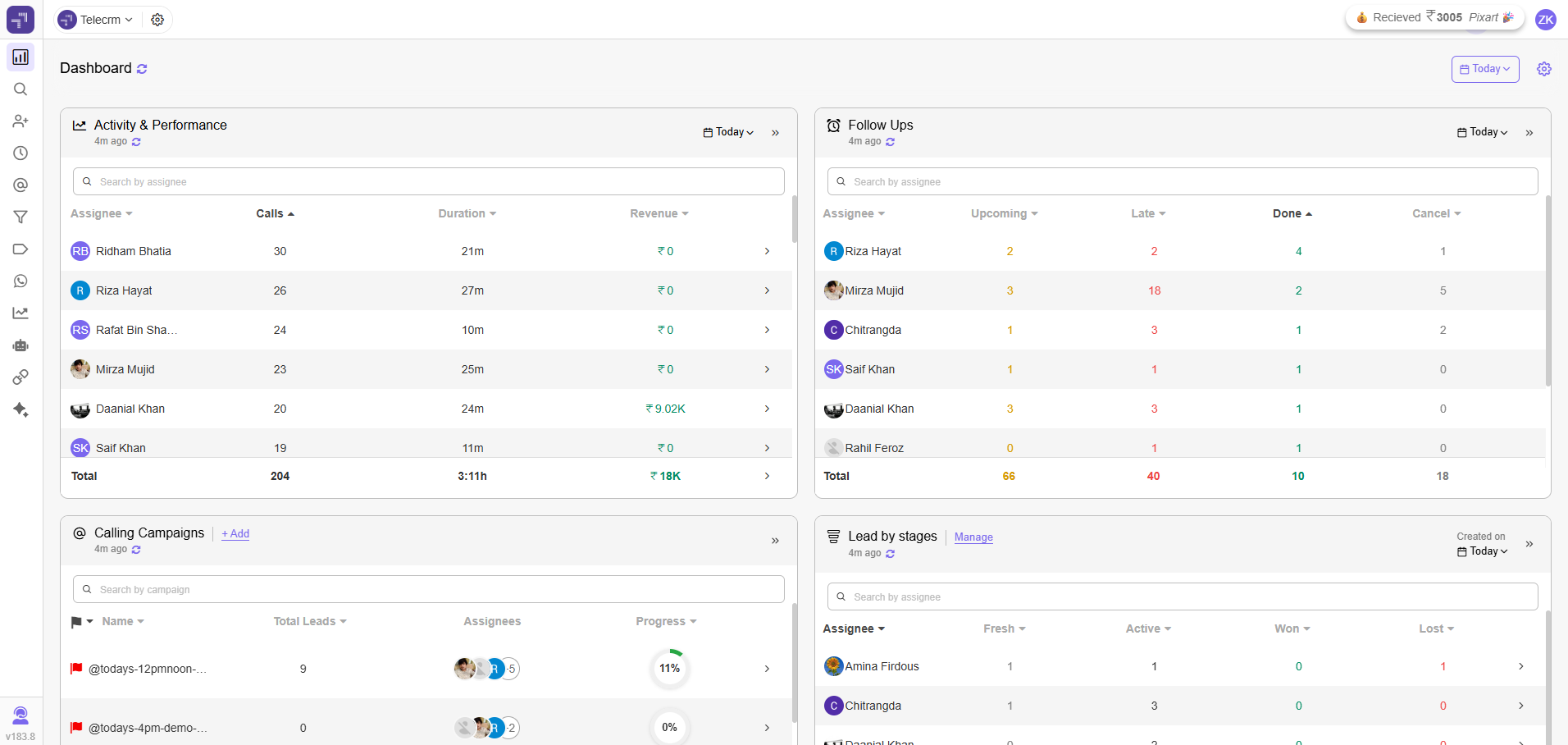
Telecrm is a full-featured CRM software built for Indian sales teams that want to do more than just dial numbers. From capturing leads to tracking conversations, it gives you one clean dashboard to manage your entire sales and support flow.
With Telecrm, you can:
Want to learn more? Book a FREE demo to see Telecrm in action!
Manual dialing might feel familiar, but it is holding your team back.
If your reps are spending more time entering numbers than talking to leads, you are not just losing time — you are losing business. Auto dialers solve this problem by removing the repetitive steps and helping your team focus on what actually drives sales: meaningful conversations.
But don’t stop at just auto dialer.
With a powerful CRM like Telecrm, you get calling, lead management, AI summaries, WhatsApp automation and performance tracking, all in one place.
You don’t need more apps. You just need one solid system.
An auto dialer is a software tool that automatically calls numbers from your lead list without your sales rep having to dial them manually. It connects the rep only when someone picks up and skips calls that are busy, unreachable or not answered, saving time and boosting productivity.
Yes, auto dialers are legal to use for business purposes, as long as you follow the relevant rules and regulations. For example, in the US, the Telephone Consumer Protection Act (TCPA) requires businesses to get prior consent before making automated calls to consumers. In India, while there is more flexibility, it’s still important to avoid calling DND numbers and ensure ethical usage.
The key difference is who dials the number. In manual dialling, the sales rep physically enters each number and places the call. In auto dialling, the system handles the dialling process and connects the rep only when a lead answers. Auto dialers save time, reduce errors and help reps make more calls per hour compared to manual dialling.



© Copyright 2025 Telecrm.in - All Rights Reserved • Privacy Policy • T&C



© Copyright 2025 Telecrm.in - All Rights Reserved • Privacy Policy • T&C