

Think of your B2B sales funnel as a roadmap for your teams. At the top, you’re pulling in attention with blogs, social media campaigns and the occasional paid ad. In the middle, your job shifts to qualifying and nurturing, making sure the right prospects stay engaged and continue down the path. Finally, at the bottom, your sales team focuses on converting the strongest opportunities into customers.
Without optimisation, that roadmap has gaps. Some leads drop off, others stall and valuable opportunities slip away. But with a funnel that’s been thoughtfully structured and fine-tuned, you create a smoother customer journey,one that lowers acquisition costs, improves conversions and builds long-term loyalty.
A B2B sales funnel is simply a framework that shows how potential buyers move from discovering your business to becoming paying customers. Unlike consumer sales, the B2B process usually involves longer cycles, multiple conversations and more than one decision maker. That makes the funnel more complex and also more important to manage carefully.
Each stage of the funnel requires attention. Marketing brings in awareness, nurturing builds interest and sales teams step in when prospects are ready for deeper conversations. If these handoffs aren’t smooth, valuable opportunities get lost, costs go up and teams spend time chasing the wrong leads.
That’s where optimisation comes in. By aligning sales and marketing, qualifying leads more effectively and using the right tools to stay organised, you can reduce drop-offs, improve conversion rates and grow revenue more predictably. In short, a well-optimised funnel doesn’t just bring in leads, it helps you turn them into long-term customers. Key stages of the B2B sales funnel explained
Related read: Sales Funnel vs Marketing Funnel: 8 Key Differences for MSMEs [2025]
The B2B sales funnel isn’t just a diagram; it’s the path that prospects follow from first hearing about your brand to becoming loyal customers. Understanding each stage helps your sales and marketing teams work together, nurture the right leads and guide buyers smoothly through the journey.
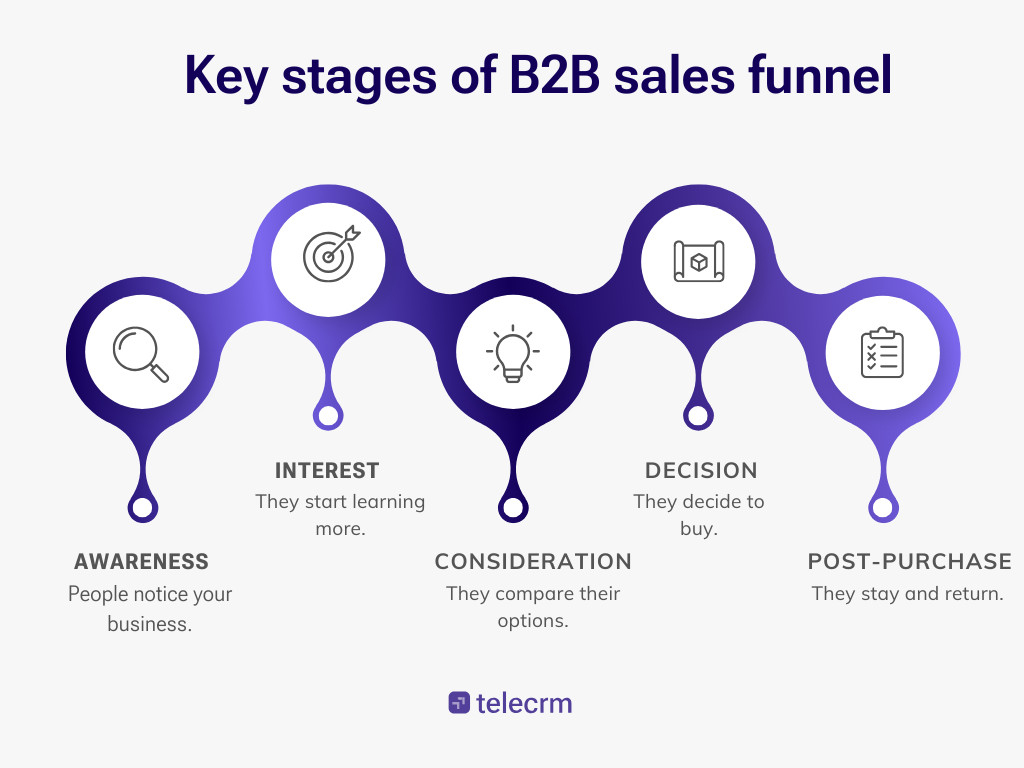
This is where people first discover your business. They might see a blog post, a social media campaign or a paid ad. The goal here is simple: attract attention and introduce your solution to the right audience.
Once prospects know you exist, they start exploring further. They’ll visit your website, read case studies or sign up for a webinar. This is your chance to share valuable content, highlight industry insights and show how you can solve their problems.
At this stage, prospects are weighing their options. In B2B, that often means several decision makers are involved, which makes the process more detailed. Providing clear comparisons, tailored demos or a free trial helps them see the value you offer.
Here’s where sales teams step in to close the deal. Personalised follow-ups, customer testimonials and transparent pricing all help reduce hesitation. The focus is on building trust and making it easy for the buyer to say “yes.”
The funnel doesn’t end once a deal is signed. Nurturing existing customers with strong support, regular check-ins and loyalty programs keeps them engaged. Happy clients often become repeat buyers and advocates, driving long-term growth.
Even with a well-structured sales funnel, B2B companies often struggle to keep prospects moving forward. Leads may drop off at different funnel stages, or teams may spend too much time chasing the wrong opportunities. Recognising these challenges and tracking the right metrics helps you spot weak points and improve overall funnel performance.
By tracking these metrics, your sales and marketing teams gain valuable insights into where your funnel is working and where sales funnel optimisation can make the biggest impact.
A B2B sales funnel works best when every stage is backed by the right strategies and tools. From attracting new leads to retaining loyal clients, the goal is to create a seamless customer journey that reduces drop-offs, boosts conversion rates and drives business growth.
At the awareness stage, focus on high-quality lead generation. For commodity businesses, this could mean building a simple commodity lead qualification workflow to filter out unfit leads early.
Use content marketing, social media campaigns and well-targeted paid ads to attract the right target audience. Well-designed landing pages with clear calls-to-action can convert visitors into marketing-qualified leads.
In the interest stage, prospects want answers and reassurance. This is where automated lead nurturing sequences become valuable. Whether it’s webinars, industry guides, or even a free trial, these touchpoints build trust without overloading your sales teams.
Tools like WhatsApp lead management also play a role, letting you send reminders, answer queries and keep leads engaged in real time.
During the consideration stage, prospects are weighing their options. In commodity broker sales processes, this often involves multiple conversations and several decision makers. Sharing case studies, customer testimonials and clear product comparisons helps build trust. Here, CRM for B2B sales acceleration, lead scoring and account-based marketing tools make it easier to track progress and focus on the most promising prospects.
At the decision stage, timing matters. Equip your sales teams with proven B2B lead conversion strategies, demos and negotiation frameworks to speed up the sales cycle. Platforms like WhatsApp have also become crucial—closing deals on WhatsApp allows faster responses and more personal communication. Automated reminders and smart sales pipeline management for traders ensure that no lead slips through the cracks.
Optimisation doesn’t stop once a deal is signed. Long-term customer retention depends on support, personalisation and consistency. Using tracking lead progress in commodity trading systems, loyalty programs and follow-ups builds stronger relationships with existing customers.
When combined with building trust with B2B clients, this approach turns happy customers into advocates, driving referrals and sustained revenue growth.
Also read: Sales Pipeline Visibility CRM: A Complete Guide for 2025
The way buyers move through the B2B sales funnel is changing. Longer journeys, more decision makers and higher expectations for personalisation mean businesses must continuously adapt. Here are the trends and best practices shaping the future of sales funnel optimisation.
Artificial intelligence, predictive analytics and advanced CRM systems are helping teams anticipate needs and prioritise leads. Features like WhatsApp for lead scoring and AI-driven analytics reduce wasted time on low-fit prospects and improve sales efficiency.
With multiple stakeholders involved, account-based marketing (ABM) continues to gain ground. Instead of casting a wide net, ABM aligns marketing resources to target accounts, tailoring outreach for every decision maker in the process.
Companies are working to create shorter sales cycles by streamlining communication, tightening their commodity broker sales process and improving lead qualification. Integrated marketing and sales automation tools keep prospects moving without unnecessary delays.
Also read: Sales Automation: Definition, Strategies, Benefits & More for 2025
The most future-ready companies treat acquisition and retention with equal weight. Ongoing customer engagement, loyalty programs and proactive support ensure that existing customers stay satisfied while also helping attract new prospective customers.
The future of B2B sales funnel optimisation lies in blending data, automation and human connection. Whether it’s through WhatsApp lead management, AI-based scoring, or personalised outreach, the businesses that balance technology with empathy will see stronger business growth and deeper loyalty.
A B2B sales funnel isn’t just a diagram — it’s the backbone of your entire sales process. From the first click on a social media campaign to long-term customer loyalty, every stage plays a role in shaping how prospects move through their buying journey.
When you focus on sales funnel optimisation, you reduce leaks, improve conversion rates and make better use of your marketing and sales efforts. More importantly, you give your sales teams a clear path to follow, ensuring they spend their time on the most promising prospects rather than chasing dead ends.
By combining the right marketing strategies, CRM systems and lead nurturing campaigns, you can build a funnel that doesn’t just generate leads but converts them into long-term, satisfied customers. Optimise today and you’ll see the impact not just in numbers, but in stronger relationships and sustainable business growth
Ready to improve your funnel? Start optimising your B2B sales funnel today with the right tools and strategies. Book a free demo now.



© Copyright 2025 Telecrm.in - All Rights Reserved • Privacy Policy • T&C



© Copyright 2025 Telecrm.in - All Rights Reserved • Privacy Policy • T&C