

If you’re in travel sales, you don’t need anyone to tell you how tough it is these days. The challenges for travel sales teams like yours aren’t just about finding more leads; they’re more than that.
You have changing customer preferences and high competition. Online presence matters more than ever. Then there’s the adoption of better digital technology and the demand for highly-customised services, which make the job even harder.
If you want to stand out in this market, you need to get your travel management processes right, ditch the old way of doing things and provide a better customer experience than your competitors.
In this blog, we’ll look at the common challenges travel sales teams face today and how CRM can help solve them.
On the ground, most travel sales teams still rely on scattered processes and tools to handle enquiries. And with both OTAs (online travel agencies) and traditional agencies trying to keep up with fast-changing customer expectations, even experienced teams find themselves struggling to stay on top.
Let’s look into some of the biggest challenges faced by travel sales teams in India:
You get too many trip enquiries through calls, WhatsApp, website and forms. And then you keep all this data in your registers or Excel sheets. You send this data across teams via email. Too much is happening on too many platforms.
When the data is scattered across tools, you will face the challenge of keeping track of it all and in between, leads may get lost without you even noticing it.
The reality is most reps don’t know who’s still at the enquiry stage, who needs a follow-up and who’s ready to close a booking. Because the amount of data is too large, it becomes difficult to keep track of lead status or remember details like why they may’ve dropped off. As a result, some leads get forgotten completely, while others get the same calls from different reps, and in both cases, the chance to close a booking is lost.
And travel managers? They face an even bigger headache: without visibility, they can’t forecast revenue, measure team performance or decide what to improve.
Look at these scenarios:
# 1- Rep gets an enquiry call, picks up and gives all the required travel details (destinations, travel plans, budget), but doesn’t log details anywhere. When the customer calls back later, either the rep forgets what was discussed or some other rep picks it up who has no clue.
#2- A traveller asks for a trip quotation. You promise to share it, but forget to set a reminder. By the time you remember, the booking is already made elsewhere.
Because things are handled manually, there’s no system and no stored context; follow-ups are slow, which eventually costs you a loss of opportunity.
In travel agencies, you need tight coordination between sales, marketing, operations and the finance team so that everything happens smoothly across the customer journey. When these teams don’t work on a single system, gaps appear.
One example is when leads don’t match what sales actually needs — a classic case of misaligned marketing & sales travel teams. Customers end up chasing multiple people for booking one trip, which creates confusion, poor experiences and lost trust.
Most businesses struggle not because clients have high personalisation expectations, but because sales reps lack the in-depth data needed to customise offers. Past trips, itineraries, budget ranges, special preferences & even details like corporate travel policy — all of this is scattered or not recorded at all.
Without those details, reps are left pitching “one-size-fits-all” packages. Clients may not always complain, but they won’t be impressed either, and that’s a silent deal-breaker.
When you need to announce a festive discount or a last-minute deal, most travel agencies first spend time figuring out who to send it to because customer data is scattered. Then the messages are sent manually across WhatsApp, email and SMS, which is very time-consuming. And by the time the message finally reaches everyone, the campaign has already lost its edge.
Promotions shouldn’t feel this messy, but without automation, they always do.
When a sales rep leaves, it doesn’t just affect rapport with clients; it disrupts the entire sales workflow. All the trip details, and client information they gathered often leave with them.
While trust can be rebuilt, this situation creates two big problems. First, collecting, and sharing customer information is difficult when it’s scattered across multiple places. Second, reassigning leads to a new rep/replacement becomes messy without a proper system.
That transition period creates delays, missed follow-ups and plenty of customer frustration. These situations demand prompt action from travel managers so clients don’t feel ignored and slip away.
As you already know, in the travel business, enquiries don’t come in evenly. During peak holiday seasons, sales teams are flooded with customers they can’t handle (from leisure trips to corporate travel bookings) and in off-seasons, the pipeline dries up.
Without proper tracking and forecasting, it’s tough to prepare resources, assign work fairly or run campaigns that balance the highs and lows. The result? Missed opportunities in busy times and inactive teams in slow periods.
Travellers do thorough research when looking for a travel management company, agency or business travel management partner. They check Google reviews, browse Justdial ratings or even ask for recommendations before choosing one.
If your business doesn’t have enough reviews or worse, has inconsistent reviews, prospects will quickly move on to a competitor. With online travel agencies offering transparent pricing and easy comparisons, traditional agencies need to work twice as hard to prove they’re reliable and can deliver a great travel experience worth trusting.
Winning a customer once is tough, but keeping them is even harder. Most travellers think they’ll “try a new travel management company for their next trip” if they find a cheaper deal or a slightly faster response.
In India’s price-sensitive market, loyalty is delicate — customers rarely stick around unless they feel genuinely valued. Without structured follow-ups, referral programs or a proper travel program to reward loyal customers, travel businesses end up chasing new leads constantly while past customers quietly slip away.
Most travel sales teams aren’t short on effort; they’re short on structure. Leads get handled, calls get made, quotes get shared… but without a proper system, things slip through the cracks. That’s why overcoming sales challenges in the travel industry isn’t about working harder, it’s about working smarter and that’s exactly what a CRM helps you do.
And with the right travel CRM, like Telecrm, you can bring all your processes together and actually fix these problems instead of just managing them. Here’s how:
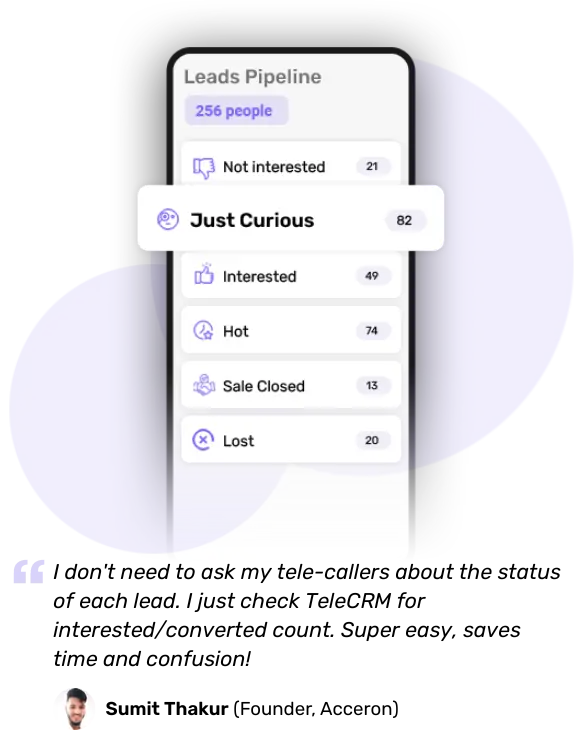
Every lead, every enquiry — whether for general trips or business travel management — that comes from sources like calls, Facebook or Google ads, booking platforms, emails, etc., lands in a single place, automatically assigned to the right travel agent and tracked. Statuses like “Enquiry received” or “Quotation sent” can be tagged and travel managers finally get the visibility they need for effective sales pipeline management.
Challenges solved: lost leads, no visibility into sales pipeline and slow follow-ups.
No more forgotten calls or missed quotations. CRM software can schedule reminders and automate WhatsApp/SMS/email nudges, without you relying on sticky notes or memory.
The system even helps with customer retention — sending bulk festive offers, loyalty rewards or referral invites to past customers in just a few clicks. This way, staying in touch isn’t a manual chore; it’s a consistent process.
Challenges solved: slow responses, lead leakage, inconsistent campaigns and weak customer retention
Related read: How Travel Sales Automation Helps Travel Agencies Boost Bookings [2025]
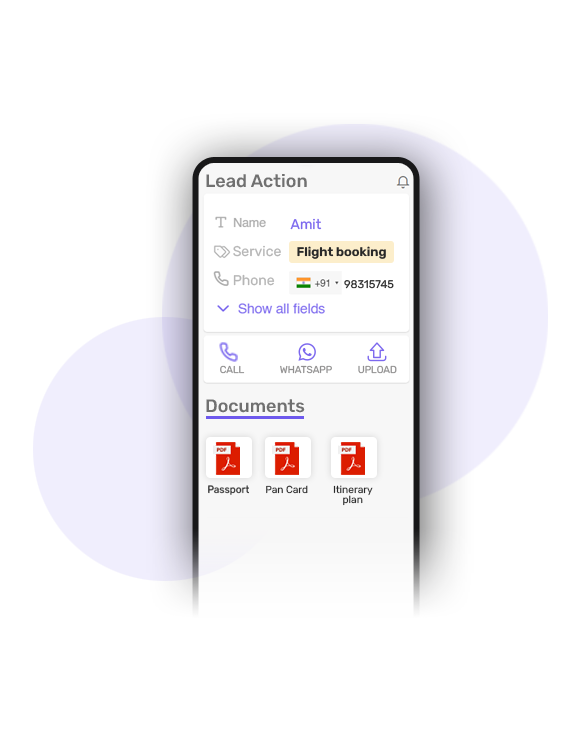
Every customer has a single profile that shows their past trips, travel data, interactions, preferences and in the case of corporate clients, their company’s travel policy. Custom itineraries and quotations can be created using this information and instantly shared on WhatsApp or email.
So when a rep leaves, the new one can pick up with full context — no awkward “Can you repeat what we discussed last time?” moments.
Plus, after each trip, the system can automatically request reviews or feedback, helping you build trust and a strong online reputation over time.
Challenges solved: lack of personalisation, broken continuity after a rep exits and reputation management.
With CRM, sales, marketing, ops & finance teams stop working in silos. That means when sales promises a package, ops can see the required travel arrangements, finance already knows what to bill and marketing has the context to run campaigns that actually align with what’s being sold.
From invoices & payments to expenses incurred, vendor costs and refunds, everything is tracked in one system, keeping every team on the same page.
Challenges solved: team silos, miscommunication and poor customer experience.
A CRM doesn’t just capture data; it gives travel managers insights they can act on. You get to access real-time reports on travel sales performance with things like enquiry conversions, sales per agent & call volumes. You also see insights on time spent per lead and overall customer satisfaction. Trends like peak demand months, sudden booking spikes or best-performing packages are easy to spot, so you can plan resources, forecast revenue and launch travel marketing campaigns with confidence.
Challenges solved: unpredictable demand swings, lack of visibility into team performance and guesswork in decision-making.
The best part about using Telecrm is that it’s a comprehensive solution built for all travel businesses. It doesn’t force you to change the way you work; it adapts to you. You can set up workflows and sales processes that match your business. And with a full-featured mobile app, your team can manage leads, share itineraries and follow up with customers on the go.
Related read: Travel Sales Metrics: 23 Key Numbers Every Agency Should Track
Know that you need more than hustle to overcome travel business challenges and keep up with industry changes. You need to invest in smarter travel management systems that streamline sales, because scattered tools and manual tracking will only hold you back.
The real CRM benefits for travel business come when your team works on one system – managing leads, handling trip enquiries, personalising offers and tracking results in one place. That’s how you boost travel sales performance, secure more bookings, provide great service and stay in sync with Indian travel market trends.
Ready to get everything under control and be stress-free? Book a free demo today and see how Telecrm can help you solve your business challenges.
A lot of time gets wasted on updating sheets, digging through old conversations or repeating the same tasks. A travel management CRM cuts all that out and improves sales team productivity by automating things like lead tracking and assignment, reminders, follow-ups, messaging campaigns and more.
Increasing sales isn’t about adding more travel agents; it’s about making every enquiry count. A significant challenge for most agencies is turning leads into customers and that’s where a CRM for travel management helps.
It lets you personalise offers with detailed customer profiles, including a company’s travel policy for corporate clients, re-engage past travellers with targeted campaigns and focus on the strategies that actually bring bookings. With clear insights and a structured sales process, you can make informed decisions and focus on what drives revenue instead of getting stuck in trial & error.
Sales team management software or travel management software provides your team with a single platform to keep track of everything, from travel & booking details, customer history and preferences to ongoing enquiries and follow-ups. It helps travel agents personalise offers, respond faster and run targeted campaigns that actually convert.
It also supports business travel management by making processes more organised. At the same time, travel managers can access performance & data-driven insights to improve sales. In short, it keeps your team organised, your customers happy & your bookings growing.



© Copyright 2025 Telecrm.in - All Rights Reserved • Privacy Policy • T&C



© Copyright 2025 Telecrm.in - All Rights Reserved • Privacy Policy • T&C