

The first time you become a manager, nobody hands you a playbook. You don’t get a crash course on setting expectations or handling conflicts. You don’t get a cheat sheet on how to talk to different personalities or how to motivate someone who has mentally checked out of work. You just get a team, a title and a silent expectation to “figure it out”.
That’s why most first-time managers struggle.
Some days you feel like you’re doing too much. Some days you feel like you’re not doing enough. Your team looks busy, but deadlines still slip. Communication feels scattered. You try to be helpful but end up over-explaining or micromanaging. You try to give feedback, but the conversation feels heavier than it should.
And slowly, you realise something important. Managing a team is a skill. A structured, learnable skill. Not something that magically improves with more calls, more meetings or more pressure.
This blog takes the academic ideas you’ll find in popular management guides and turns them into something clearer and more practical. You’ll understand what team management really means, how it impacts your team’s performance and how to apply proven principles in your daily routine. The goal is simple: give you a structured way to manage people with confidence and clarity.
Team management refers to the process of guiding a group of people toward shared goals while ensuring that everyone stays aligned and productive. It is a mix of leadership skills, core management skills and soft skills that help a team leader organise work, communicate effectively and track team performance.
In simple terms, team management involves three things
Good team management is not limited to assigning tasks or reviewing work. It includes understanding how your team thinks, how they respond to different situations and how they collaborate with other team members. This is where emotional intelligence, active listening and constructive feedback become important.
Team management is also different from team leadership. Leadership focuses on inspiration and direction while management focuses on execution and consistency. Both are important for a successful team and both influence how team members perform in day to day work.
On a practical level, a team manager handles
You can think of it as the backbone that keeps the project team organised. Without clear team management skills, a team struggles with coordination, deadlines and completing tasks. With strong management skills, even a small group can function as a collaborative team that moves in sync.
Effective team management is important because it shapes how team members work, communicate and stay motivated. When a team manager sets clear expectations and builds a collaborative environment, the entire team works with more confidence and clarity.
Good team management improves team performance in three major ways
Research shows that engaged employees see around 20 % better individual performance and up to an 87 % reduction in desire to leave. Another study from Gallup found that 70 % of variance in team engagement is determined solely by the team manager.
A well-managed project team knows what needs to be done, who owns what and how to track progress. This reduces confusion and keeps everyone on the same page. When people understand their role in the organisational structure, they can focus on completing tasks without unnecessary back-and-forth.
Effective communication:
Effective communication also plays a key role. Teams that share updates, ask questions early and follow clear communication tools avoid delays. This directly improves employee engagement and strengthens day-to-day collaboration.
Cultural impact:
There is also a cultural impact. Engaged employees work better when they feel supported by their team leader. A supportive leadership style builds trust, fosters teamwork and creates a positive work environment where people feel comfortable sharing ideas or raising concerns.
On the other hand, poor team management slows down team progress. Deadlines slip, conflicts pile up, motivation drops and the team becomes reactive instead of proactive. When this happens, even the best technical skills cannot save the project.
In simple terms, effective team management keeps your team motivated, aligned and capable of delivering high-quality work. It turns a group of individuals into a collaborative team that performs well and grows consistently.

Every manager has a natural way of guiding people. This approach influences how decisions are made, how team members communicate and how conflicts are resolved. In academic terms, this is known as your team management style. Understanding these styles helps you adjust your behaviour based on the situation, workload and team maturity.
Here are the major styles explained simply.
You set the direction and the team follows with clarity. It works well when your team is new, goals are urgent or the structure is weak. It builds focus because everyone knows what to do.
But if overused, it can make team members hesitate to contribute ideas.
Useful when
Be careful about
You involve team members in discussions, take inputs and then make the final call. It creates ownership, improves employee engagement and builds a collaborative environment.
The trade-off is slower decision-making when too many opinions come at once.
Useful when
Be careful about
You give team members full freedom to manage their work. It suits teams with strong technical skills or virtual teams that operate independently.
The risk is lack of clarity for people who need structure or guidance.
Useful when
Be careful about
You help each person grow by focusing on strengths, soft skills and professional development. You provide feedback often and guide them through challenges.
This style builds long-term trust but requires consistent time and attention.
Useful when
Be careful about
You motivate employees by connecting everyday work with a larger purpose. You use excellent communication skills and a strong company vision to inspire your team.
This style boosts motivation and helps the entire team stay aligned during change.
Useful when
Be careful about
You support your team by removing obstacles, improving workflows and focusing on their well-being. This style builds trust and improves the work environment.
The drawback is reduced authority if boundaries are not clear.
Useful when
Be careful about
Choosing the right style
A successful leader rarely sticks to one approach. You may begin with structure, shift to collaboration and then move toward coaching as confidence grows. The goal is to use the style that supports your team’s work in that moment.
Flexible managers handle stress better, solve problems faster and guide teams toward better team performance without friction.
Strong team management skills come from simple habits practiced consistently. These tips combine academic principles with real-world routines to help any team manager guide their team members with clarity, confidence and steady performance.
Most team performance issues trace back to one thing — unclear expectations. When team members don’t fully understand what to do, why it matters or what the final outcome should look like, even simple tasks turn into confusion. Clear expectations are the first step toward effective team management because they give your entire team a shared direction.
A team manager can avoid half the daily friction by setting expectations that cover four things
This keeps everyone on the same page and reduces the back and forth that slows down team progress. It also makes it easier to track team performance because you know what you asked for and what the output should match.
Here’s a simple framework for giving instructions that team members understand instantly
For example, instead of saying “Can you prepare the report?”
Try
“Create a three-page report with numbers from last month. Add all pending tasks, team progress and key risks. Share it by 5 pm tomorrow in the project folder.”
This one shift helps your project team stay aligned, reduces confusion across other team members and removes the guesswork that causes delays. Clear expectations also support different team management styles because, whether you use a coaching style or a participative one, clarity sets the tone for good team management.
Strong expectations give your entire team confidence, reduce stress and create a collaborative environment where the team’s work moves without friction.

Effective communication is one of the most important team management skills. When your message is clear and consistent, team members know exactly what to prioritise and how their work connects to company goals. Poor communication creates confusion, slows down decisions and affects team performance.
A team manager should follow the 3Cs of good communication
This helps your project team stay on the same page and reduces misunderstandings across other team members. It also makes conflict management easier because issues are discussed early instead of becoming bigger later.
Here are simple habits that improve everyday communication
Example, instead of saying “Let’s finish this soon”
Say “Finish the first draft by 3 pm so the team leader can review it by EOD.”
Good communication helps create a collaborative environment, keeps the team motivated and supports any management style you follow.
Delegation is a core management skill because it helps the entire team work faster without overloading the team manager. The mistake most managers make is delegating steps instead of results. When you delegate outcomes, team members know what they are responsible for and how their work will be measured.
Use this simple structure when delegating
Example, instead of saying “Collect the data and make slides”
Say “Create a five-slide deck showing last month’s team performance and key risks. Share it by 4 pm.”
Delegating outcomes builds accountability, reduces micromanagement and helps the project team stay aligned without constant follow-ups.
A collaborative team performs better when there is rhythm in the workflow. Weekly routines give your team members clarity, reduce stress and make it easier to track team performance. They also prevent small issues from piling up.
Follow a simple weekly structure
This routine works for in-office teams, virtual teams and hybrid setups. It supports effective communication and ensures the entire team stays on the same page. When routines are stable, team members know what to expect and can plan their work with confidence.
Team members share ideas only when they feel safe. A positive work environment encourages people to speak up, admit mistakes and give honest feedback. This is essential for good team management and helps the team leader understand issues early.
You can build psychological safety through simple habits
A safe environment improves employee morale, strengthens teamwork and helps create an engaged team that performs well even during stressful projects.

Feedback is part of successful team management. When it is given regularly, team members improve faster and the overall quality of work increases. When it is delayed or ignored, small issues turn into bigger problems.
Use a simple feedback method
Example, instead of saying“Your work needs improvement”
Say “The report missed three key data points. Add them in the next version so the project manager has complete information.”
Constructive feedback strengthens leadership skills, prevents repeat mistakes and shows the team that improvement is a shared goal, not a punishment.
Conflicts happen in every project team. People come from different backgrounds, think differently and solve problems in their own way. When these differences are not managed well, they affect productivity, slow down team performance and weaken trust. That is why conflict management is an essential part of good team management.
A team manager should address disagreements early instead of letting them grow. Most conflicts start small
If ignored, these minor issues turn into frustration and eventually affect the entire team.
Here’s a simple way to handle conflicts professionally
Handling conflicts early protects the work environment, keeps team members focused on completing tasks and prevents long-lasting friction. Teams work better when they know disagreements will be handled fairly and respectfully.
Every team member brings a mix of technical skills, soft skills and personal preferences. When tasks are assigned without considering these strengths, the team struggles. Work slows down, errors increase and other team members have to step in to fix avoidable issues.
A successful leader observes how people think, plan and solve problems. This helps you assign work that matches their natural strengths. For example, someone with strong critical thinking can handle research and planning while someone with excellent communication skills can handle presentations or client updates.
To play to strengths, try these simple steps
When strengths align with responsibilities, the entire team performs better. People feel motivated because they are doing work they are good at. This improves team performance management and makes your team more reliable during busy weeks.

Motivating employees is a core part of team leadership. When people understand why their work matters, they stay engaged and perform better. Motivation is not about big speeches. It is about clear communication, consistent support and showing people how their work contributes to company goals.
A team manager can motivate the team through small but meaningful actions
Clarity is a powerful motivator. When team members know what the work leads to, they stay focused. Appreciation builds confidence and makes people comfortable taking ownership. Purpose helps them understand how their work connects to the company vision.
When motivation is steady, team members contribute ideas more freely, offer support to other team members and feel confident solving problems without hesitation.
Accountability ensures that each team member takes responsibility for their part of the work. Without it, deadlines slip, tasks remain incomplete and the entire team struggles with coordination. Good team management requires a simple system where everyone knows what they own.
A team manager can build accountability through
Accountability works best when expectations are fair and visible. When people know what is expected of them, they manage their time better and communicate early if something is delayed.
This also helps project managers and team leaders understand where support is required. A culture of accountability strengthens teamwork, improves the work environment and ensures that every team member plays a meaningful part in achieving company goals.
Even the most talented team members struggle if the system around them is messy. When tasks live in chat messages, updates get lost in meetings and deadlines remain untracked, the entire team slows down. A team manager’s ability to reduce chaos is often what separates good team management from excellent team management.
Simple systems help with
You don’t need complicated tools. You just need consistency. Use one place for tasks, one method for updates and one shared routine for reviews. This can be a project management software, a shared document or even a basic tracking board as long as everyone follows it.
A system brings structure to the team’s work and helps other team members coordinate smoothly. It also supports remote team members and virtual teams because clarity reduces miscommunication.
When systems are simple, the team leader spends less time chasing updates and more time supporting the team through productive work and problem-solving.
1:1 meetings are one of the strongest tools in successful team management. They allow you to understand how each team member thinks, what they are struggling with and what support they need. Without regular 1:1s, small issues go unnoticed until they start affecting team performance.
A strong 1:1 should focus on
This is where soft skills matter. Use active listening, ask open-ended questions and take notes. The goal is not to judge performance. The goal is to understand how to make the team’s work easier, smoother and more aligned with company goals.
When done consistently, 1:1s improve employee engagement, increase trust and help a team manager identify potential problems before they affect other team members.
A good manager adjusts their management style as the team grows. What works for a new project team will not work for a mature collaborative team. This flexibility is part of strong leadership skills and is essential for maintaining steady performance.
Early-stage teams may need more structure
Mid-level teams need balanced guidance
Mature teams need autonomy
When your management style matches team maturity, the entire team works with confidence. It helps track progress easily, keeps the team motivated and allows you to successfully lead without micromanaging.

Remote team management requires more intention because you cannot rely on casual conversations or visual cues. This means your management skills need to focus on clarity, consistency and routine.
To support remote and virtual teams
Remote teams perform well when instructions are written clearly, updates are shared regularly and team members know where to find information. This reduces confusion and supports other team members who work across time zones.
Intentional management creates a collaborative environment where remote employees feel included, engaged and confident in completing tasks without needing constant supervision.
Effective team management is an ongoing skill. You improve every time you handle a conflict, delegate a task or guide a team member through a challenge. Managers who reflect on their decisions grow faster and lead teams with more clarity.
You can improve through
A successful leader learns from both good days and difficult days. When you reflect consistently, you strengthen your management style, improve decision-making and create a positive work environment where your team members feel supported.
Continuous learning keeps your management skills sharp and helps you adapt to new challenges, new team dynamics and new organisational needs.
Strong team management depends on two things: how you guide your team and the systems that support your daily workflow. Even with the best communication style or leadership skills, team members struggle when information is scattered, updates are missed or there is no central place to track progress. This is where the right tool makes your work simpler.
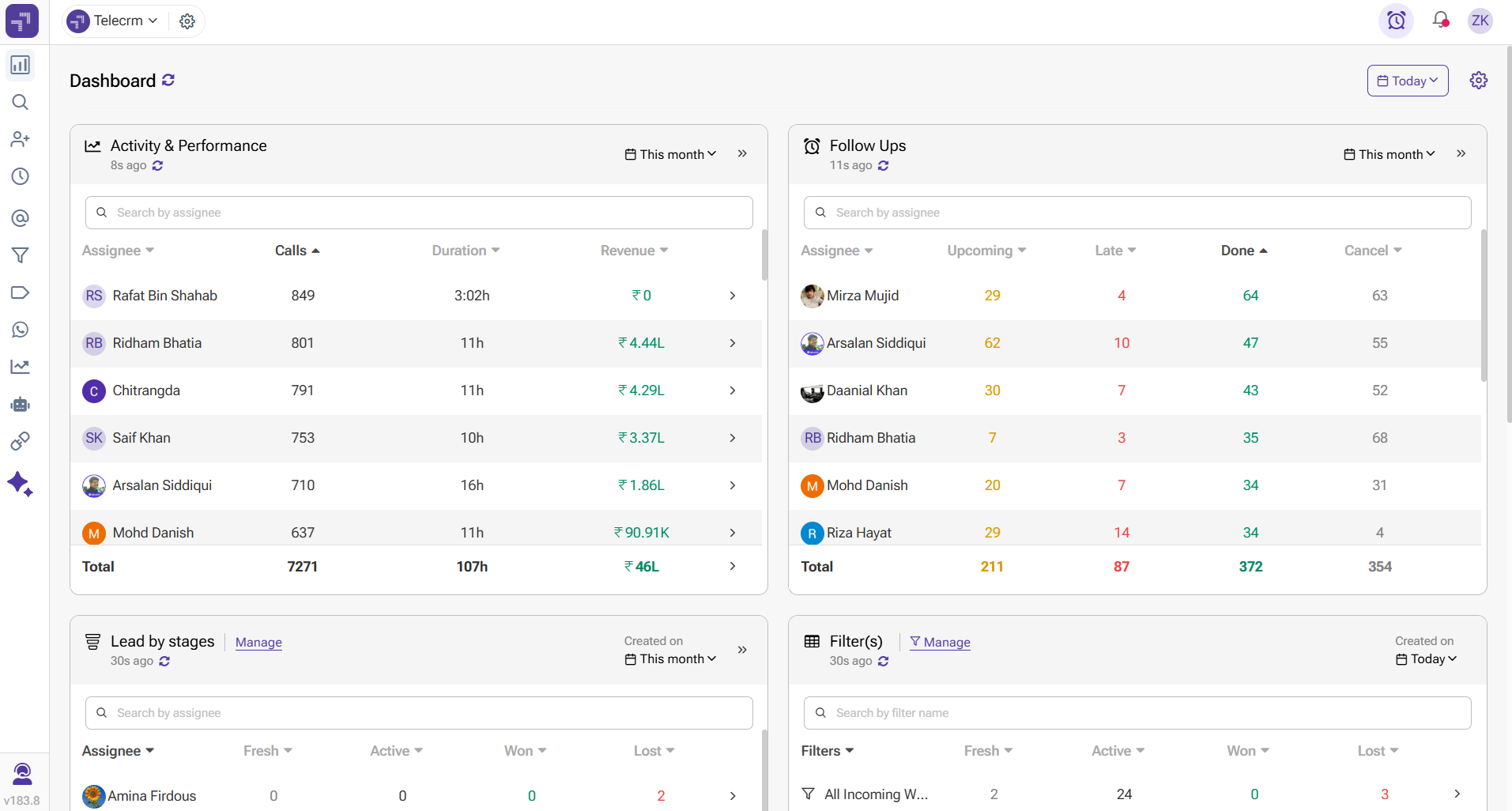
telecrm is a unified platform that helps managers organise their team’s work without creating extra steps. It brings communication, tasks, follow-ups and activity tracking into one dashboard so you always know what your team is working on, what is pending and where support is needed.
Here’s how telecrm supports day-to-day team management
With everything structured in one system, you spend less time chasing updates and more time helping your team perform better. It becomes easier to maintain consistent communication, support your team’s work and ensure that tasks are completed without confusion.
If you want your team to work with more clarity, telecrm gives you the structure to manage people, projects and communication through one clean workflow.
Team management is a learnable skill that grows through clarity, consistent communication and simple routines. This article explains what team management involves, why it is important and how different management styles influence the way a team performs. It then gives fifteen practical tips that help you delegate well, motivate your team, manage conflicts early and build a collaborative environment where people feel confident doing their best work.
When strong habits meet the right systems, team members stay aligned with company goals, complete tasks on time and communicate more effectively. Tools like telecrm support this by giving you one place to track work, follow-ups and team performance without relying on scattered information or multiple apps.
If you want to see how telecrm can help you organise your team’s work, book a free demo and try it in your own workflow.



© Copyright 2025 Telecrm.in - All Rights Reserved • Privacy Policy • T&C



© Copyright 2025 Telecrm.in - All Rights Reserved • Privacy Policy • T&C