

As a business owner, you already know how much time and money marketing can eat up.
You pay for ads, but half the time you’re not sure if the right people even see them.
You try social media, but it takes months before you notice results. Referrals help, but they’re unpredictable.
Telemarketing is different. It doesn’t drain your budget or keep you waiting. Instead of paying for impressions and clicks, you can pick up the phone and talk to people directly. One call puts you in front of a potential customer who’s ready to listen.
With a short conversation, you can:
And if the person isn’t interested? You still get quick feedback you can use to adjust your approach.
For a business owner, that means no guessing games and no wasted effort. Just direct conversations with people who could actually become customers.
In this blog, we’ll walk you through practical, simple and easy-to-use telemarketing steps. These are the same things real businesses do every day to:
…all without burning through their budget.
Telemarketing is when a business uses the phone to connect with people. It can mean reaching potential customers, following up with existing ones or running simple market research. The goal is usually to generate leads, set appointments or close sales through direct conversations.
There are a few common forms. In outbound telemarketing, businesses make calls to prospective customers to introduce their products or services. In inbound telemarketing, the calls come from customers who want information or help.
Some companies use automated telephone calls to deliver recorded messages, while others rely on a sales representative who can answer questions in real time.
Put simply, telemarketing is about contacting people directly by phone. It remains one of the most personal and immediate ways a business can start a conversation and build customer relationships.
Telemarketing is not one-size-fits-all. Businesses use it in different ways depending on whether they want to find new leads, handle customer questions or reach a wide audience quickly.
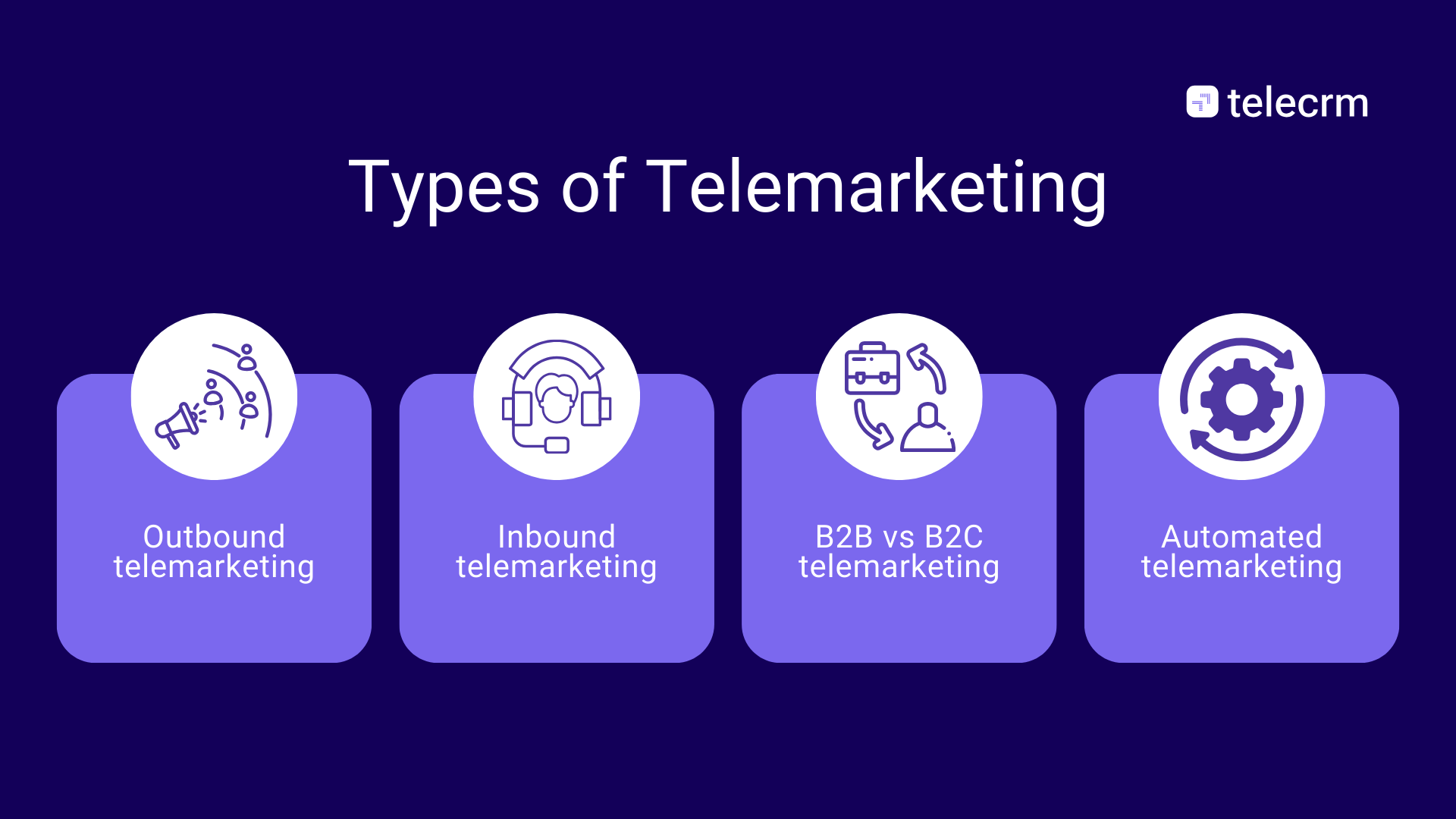
Understanding the types of telemarketing helps you pick the right approach for your business goals.
This is the most common form. A business makes calls to potential customers to talk about its products or services. The aim is usually to generate leads, set appointments or make sales. Outbound calls are proactive — the company reaches out first.
Here, the customer makes the call. It could be to ask a question, get support or learn more about an offer. Inbound telemarketing is more about handling interest that already exists and helping people move closer to a decision.
Telemarketing works in both spaces. B2b telemarketing focuses on reaching other businesses, often with longer sales cycles and multiple decision makers. B2c telemarketing is about calling individual consumers, usually with shorter conversations that aim to close quickly.
Some companies use automated telephone calls to reach many people at once. These calls play a recorded message and can be used for reminders, simple offers or surveys. While cost-effective, they are less personal than speaking to a sales representative.
These three terms often get mixed up, but they are not the same. Each has a different focus and purpose. Here’s a quick breakdown.
Term | What it means | Main goal | Example use |
Telemarketing | Using the phone to connect with potential or existing customers | Generate leads, set appointments and answer questions | A company calls prospects to explain a new service |
Telesales | Selling directly over the phone | Close sales | A sales rep calls and takes payment for a product |
Cold calling | Calling people who have not shown prior interest | Spark interest, introduce an offer | A rep calls a list of prospects to pitch insurance |
This is the broadest of the three. Telemarketing is about starting and building conversations with people over the phone. It covers lead generation, market research, appointment setting and customer support. The goal is not always to sell right away but to move customers closer to a decision.
Telesales is a subset of telemarketing that focuses only on selling. The primary responsibility of a telesales agent is to close the deal, often in the same call. It’s more direct and transactional than telemarketing.
Cold calling is a telemarketing approach where you call people who have not interacted with your business before. It’s harder because prospects may not expect the call, but it can be effective for businesses that want to reach new audiences quickly.
Like any marketing approach, telemarketing comes with strengths and challenges. Knowing both helps you decide if it’s the right fit for your business.
Disadvantages of telemarketing
Telemarketing can be powerful, but it’s also one of the most regulated forms of marketing in India. Strict rules are in place to protect consumers from unwanted or fraudulent calls. As a business owner, knowing these rules isn’t optional — it’s essential.
The Telecom Regulatory Authority of India (TRAI) has set clear rules to reduce spam calls and messages. Every telecom operator maintains a Do Not Disturb (DND) registry where consumers can block promotional calls and texts.
Under the Telecom Commercial Communications Customer Preference Regulations (TCCCPR), every telemarketer — whether a large company or a small firm — must register with TRAI through their telecom operator.
Even if a number is not on the DND list, you cannot just start blasting calls at random times. Consent matters.
Staying compliant is not just about avoiding fines. It builds trust. Businesses that ignore the rules often get blacklisted, which hurts their brand. On the other hand, following the regulations shows that you respect your customers’ privacy and time, making them more likely to hear you out.
Telemarketing works best when it feels like a proper conversation, not just someone reading a script. If you want your team to get real results, here are a few things to keep in mind.
Don’t hand your team a rigid script that makes them sound like robots. Give them a guide with a few key points:
👉 Think of the script as a map, not a word-for-word speech.
Most customers won’t say “yes” straight away. Your team needs to know how to listen, stay calm and deal with common replies like “I’m not interested” or “Call me later.”
👉 A rep who listens well will often win trust faster than one who just pushes the pitch.
Dialling numbers one by one or keeping notes in Excel will only slow you down. A proper system makes life easier.
👉 The right tools mean fewer mistakes, better tracking and more time spent talking to customers.
You don’t need fancy reports to start with. Just track a few key numbers:
👉 These numbers show you what’s working and where your team needs a little help.
Telemarketing gets messy fast once you’re handling dozens of calls a day. A CRM keeps things simple and organised. Here’s how it helps:
Not every CRM is built for telemarketing. If you want your calling team to be effective, here are the basics your CRM should have:
Plenty of CRM software offers some of these features, but most are designed for general sales or marketing — not for the day-to-day usage of telemarketing teams.
Telecrm is different. It’s built with calling and WhatsApp communication at its core, making it one of the best choices for Indian businesses that rely on telemarketing.
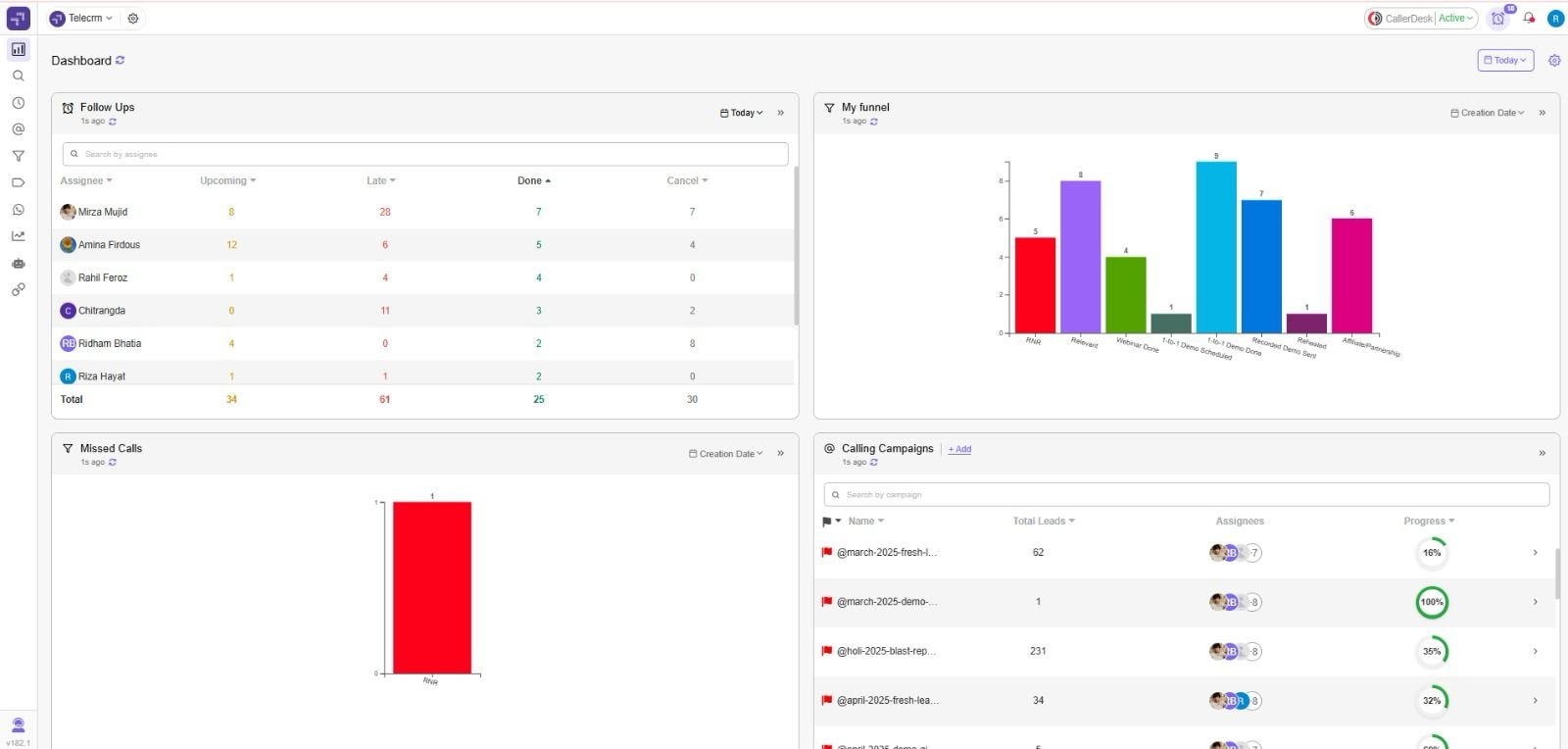
Here’s why:
Book a demo of Telecrm to know more about pricing and features
Telemarketing is changing, but it’s not going away. Here are a few trends to watch:
Telemarketing remains one of the simplest and most effective ways to connect with customers. Whether you’re just starting out or already running a calling team, the difference between success and frustration often comes down to how organised your process is.
If you’re new to telemarketing, the key is to start small but structured — clear scripts, a bit of training for your team and Telecrm to keep everything in one place. This way, you avoid the pain of scattered leads and missed follow-ups.
If you already use telemarketing in your own business, you’ll know how quickly things can get complicated — multiple agents calling, leads slipping through the cracks and no clear view of results. That’s where upgrading to a proper telemarketing CRM like Telecrm makes all the difference.
Ready to see how Telecrm can help your team connect better and sell more? Book a demo today and try it for yourself.



© Copyright 2025 Telecrm.in - All Rights Reserved • Privacy Policy • T&C



© Copyright 2025 Telecrm.in - All Rights Reserved • Privacy Policy • T&C